
Concrete paving blocks are prefabricated in many shapes and sizes. They are fully engineered products made of cement, aggregates and water, manufactured in factory conditions, ensuring consistency and accuracy. They provide a hard surface which is aesthetically pleasing, comfortable to walk on, trafficable, extremely durable and easy to maintain.
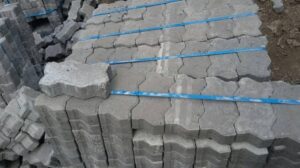 They are used to cover paved areas of the ground basically. Laid with an edge restraint over a granular bedding course, individual blocks interlock to act compositely which can distribute large point loads evenly. There are a number of standard color mixes available and the option to create your own.
Size and shape are variable. They are suitable for householders wanting to pave over their compounds, car parks or front gardens. They are also applied to harden surfaces of roads and industrial grounds.
They can be used for home yard floors, sidewalks, pedestrian areas, driveways, or heavily trafficked areas such as container ports and aircraft hard-standing because of their high resistance to rain and heavy weather. Drainage channels may be integrated. Builders can use changes in the color, texture and shape to distinguish roads from footpaths, parking lots and public space from private space.
Common types are used for:
- Roads
- Pavements
- Drainage channels
- Car parks
- Heavily trafficked areas
- Sidewalks
- Domestic driveways
- Compound surface slabbing
- Walkways/ Footpaths
- Heavy load service yards
Our vast range of block paving products for driveways are available in concrete or natural stone – such as granite and sandstone. There are a variety of sizes, colours and textures which can be used to create stunning designs. We can supply the right kind of block paving and paving bricks to suit any block paving for commercial and public sector projects, and hard landscaping projects.
Before deciding on anything, it’s important to know your options when installing a paved patio or walkway. So here is a collection of commonly used pavers of different shapes:-quad, uni, flower, pentagon, diplomat, omega, hexagon, color pavers and paving slabs.
Benefits and Performance
Concrete paving blocks offer outstanding strength and durability and are resistant to most chemical substances. Blocks are routinely tested for parameters such as splitting strength and weathering, abrasion and slip/skid resistance, to ensure conformity with the requirements of This offers specifiers and suppliers maximum confidence in the wide range of products available on the market.
Use
Concrete paving blocks are suitable for a range of applications from ultra-heavy duty areas, such as industrial units, container stacking yards and airport pavements, to lightly trafficked residential areas and hard landscaping projects. Paving blocks can also be used in conjunction with precast concrete flags, with coordinating sizes, to give variety combined with consistent surface characteristics.
Repair and rehabilitation of worn hard surface areas
Worn out road surfaces and other areas such as sidewalks, industrial hard-standing loading zones, and car parks can be strengthened and reconditioned by an overlay of concrete block paving on a sand laying course. The new wearing surface uses the old pavement as the base course – providing it is structurally sound. This cost saving rehabilitation technique can be completed in sections with minimal disruptions.
Restoration and re-use
Paving blocks allow sectional removal and restoration of hard standing areas using the original materials and blocks, without leaving behind any evidence of repair. The ability to recycle concrete paving blocks contributes further to its impressive environmental credentials.
Aesthetics/ look
Paving blocks are available in a constantly expanding variety of shapes, sizes, colours and finishes and can be installed in numerous bonds and laying patterns, enabling delineation of space or focus on specific features.
INSTALLATION INFORMATION
Concrete paving blocks can be put into use immediately after laying and requires only minimal maintenance. Mechanical installation techniques allow large areas to be laid with a minimum of manpower, saving both time and energy.
Before installation commences a certain amount of sorting of the product may be required to ensure consistency of color, texture and dimensional tolerance. Safe working practices should be employed at all times during the construction process and all necessary protective equipment should be worn.
Pavement Design
For most domestic applications a sub-base of 150mm should prove to be sufficient. However the paving design must be based upon the prevalent ground conditions and type and frequency of anticipated loads.
Excavation
To allow the block paving to be installed correctly, a certain amount of excavation is usually required. The depth of this excavation will be the thickness of the required sub-base plus the laying course sand and the blocks.
Edge Restraints
Edge restraints should be sufficiently robust to resist the lateral displacement from imposed loadings placed upon the pavement and are installed prior to the installation of the sub-base.
Construction
The surface should be clean and suitably close textured to prevent migration of finer material through the construction. Sub-base material should be placed in layers not exceeding 75mm in thickness or twice the nominal maximum aggregate size. Each layer should be fully compacted before the next layer is placed. Sub-base tolerance to be +5 -10mm from specified levels.
Laying Course: Materials Selection
Laying course material should consist of well-graded ‘grit’ sand (not building sand).
The material should have uniform moisture content, being moist without being saturated. Under no account must any cementitous material be present in the laying course material.
Construction
A consistent thickness of bedding material should be maintained with gradients and falls being formed in the sub-base construction, not the laying course material. Under no circumstances should the bedding sand be used as a levelling course. The laying course material is completely compacted prior to installing the paving units and the surface levelled by screeding. A small trial area of laying course material can be compacted prior to the commencement of installation, to establish its compaction properties.
As a guide, the material when squeezed in the hand should show no free water, and bind together when the pressure is released. Only sufficient laying course material should be placed within the current working period. Any disturbance of the screeded laying course material should result in rescreeding, with screeding rails being removed on completion, taking care to make good any voids.
On completion of the day’s work, no more than 1m of laying course material should be exposed, without cover by the paving units.
All areas of exposed laying course material should be covered overnight, and during inclement weather to prevent saturation or frost action.
Wearing Course Laying
Paving units should be laid on the laying course material so that the final level is within the permitted surface tolerances. String lines should be utilised as often as required, this is necessary to ensure the bond pattern is maintained and straight lines are achieved in the finished paving. The manufacturing tolerances of the paving units, profile of the site and frequency of string lines used should be taken into consideration during installation.
These factors may have a bearing on the straightness of line achievable. Paving units should be laid with a joint width of 2-5mm. Joint widths may be varied slightly in order to achieve straight lines or maintain bond, but should never exceed this size range.
We recommend that, when purchasing materials, especially in the case of larger quantities, they all come from the same batch and that the products are thoroughly mixed on site by drawing from a minimum of three packs.
Lay whole paving units first, followed by cut units around obstacles or at edges. No units should be cut down to less than one quarter of its original size to prevent looseness or dislodgement at a later date. Where it appears that only a small section of block will fit, the “inboard cutting” technique should be adopted. The use of a larger or full unit against the edge restraint, allows a smaller unit to be placed in the resulting place.
Where slopes, gradients or ramps are being constructed, placement of the units should commence at the lowest point ie: the bottom of the slope, working upwards. Where there is a risk of lateral movement of the paving units due to the gradient encountered, the provision of additional intermediate restraint should be considered.
Compaction
Compaction should be undertaken with a plate vibrator. Prior to final compaction of the surface, all joints should be filled with kiln dried fine jointing sand. All joints should remain full of jointing sand at all times, with periodic checking and re-sanding carried out where necessary. When laying square edged pavers, the presence of jointing sand between individual units must be ensured, before compaction of the wearing course is undertaken.
Where such units are vibrated in an un-sanded condition, the risk of edge spalling is greatly increased. A rubber or neoprene sole plate should be used with the vibrator to avoid impact damage to the surface of the units. This practice is important when installing concrete paving units with a decorative surface.
General
The bond pattern should be suited to the application and likely use of the paving. Areas which receive frequent vehicle turning, accelerating or decelerating should be laid in a herringbone pattern. Stretcher bond may be used successfully in very lightly trafficked areas, providing the direction of the traffic is perpendicular to the laying pattern and the paving is not subjected to the above movements. Basket weave patterns should not be used in areas receiving vehicular traffic.
Cutting
Cutting may be carried out using a diamond tipped power saw, a block-splitting guillotine, or hammer and bolster. It must however be noted that the aesthetic finish achieved will depend greatly upon the choice of cutting mechanism and level of skill. Specific equipment or blade types should be used when cutting natural stone units as those designed for cutting concrete pavers may blunt easily.
Cut blocks should be inserted prior to completion of the working period or before the onset of inclement weather. Blocks should be cut such that the resultant joint width remains within the 2-5mm tolerance. When laying to tight curves it may not always be possible to maintain a maximum 5mm joint, in which case, cut or special shaped units may have to be considered.
Inclement Weather
Installation should be discontinued (and any open work face covered) if weather conditions are such that the performance of the paving may be jeopardised. In adverse weather conditions, units should not be laid on saturated laying course material. The filling of joints is not possible in damp conditions, and should be topped up at the earliest opportunity. All unfinished areas and stockpiles of materials should be covered in the advent of inclement weather to prevent saturation.
Contact us
We pride ourselves on our customer service and technical advice across our products.
Are you looking for block paving for domestic driveways or larger commercial landscaping projects? Our comprehensive ranges can provide the perfect solution.
Are you a homeowner, house builder or installer? Our paving blocks are available in a wide selection of colours, shapes, sizes and finishes so you can be sure to find a product that stylishly enhances any home.
Are you a commercial buyer, public sector decision-maker or architect? Our concrete block paving products are ideal for every kind of hard landscaping project – from high streets and car parks to housing developments and ports.

2 thoughts on “Paving Blocks”
hi
nice post